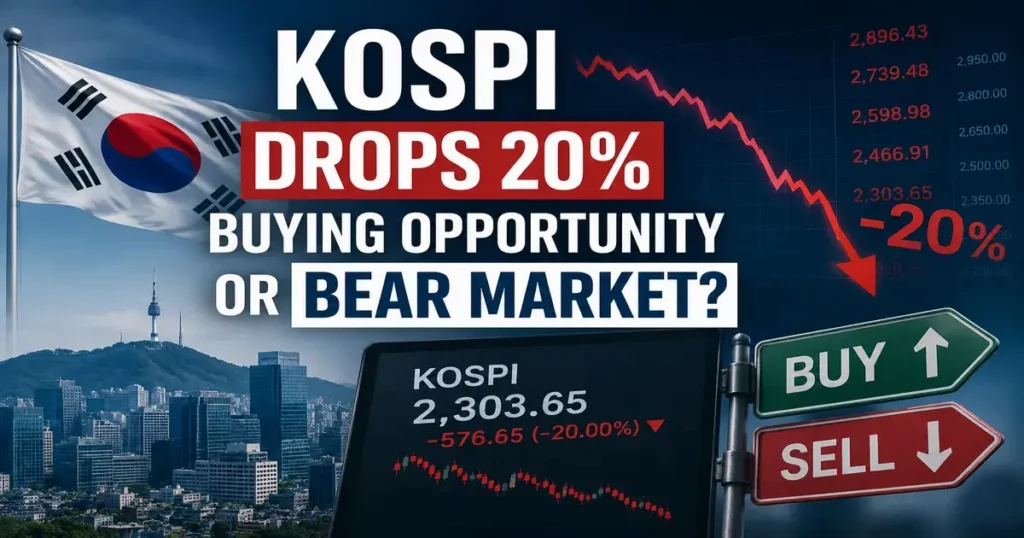
KOSPI Falls 20%: Buying Opportunity or the Start of a Bear Market? Expert Analysis
The KOSPI Index has fallen nearly 20% from its record high, raising concerns among investors worldwide. Is this the beginning of a prolonged bear market, or does the correction present a compelling long-term buying opportunity? Here’s what the latest market analysis suggests.
A Sharp KOSPI Correction Shakes Investor Confidence
The KOSPI Index, South Korea’s benchmark stock market index, recently declined nearly 20% from its all-time high, triggering widespread concerns among both domestic and international investors.
The sudden sell-off has fueled fears that the powerful rally in Korean equities may have come to an end. However, one research report published approximately two months before the correction has drawn significant attention after accurately identifying signals that suggested the market was approaching a peak.
The report was written by Jae-man Lee, Global Investment Strategist at Hana Securities, who argued that an important warning sign would emerge if SK Hynix surpassed Samsung Electronics in market capitalization.
Although no market forecast is guaranteed, the report has become one of the most widely discussed investment analyses in South Korea because of its unusually accurate timing.
Why SK Hynix Overtaking Samsung Electronics Matters
According to Lee, the market capitalization shift was never simply about determining which semiconductor company deserved a higher valuation.
Instead, it reflected a broader psychological signal.
When investors become willing to pay increasingly higher prices based on future expectations rather than current earnings, equity markets often enter an overheated phase. At that point, even minor disappointments can trigger significant corrections.
Financial history provides a similar example.
During the dot-com bubble in 2000, Cisco Systems briefly became the world’s most valuable company, overtaking both Microsoft and General Electric. Soon afterward, technology stocks experienced one of the largest crashes in modern financial history.
While today’s AI-driven semiconductor boom differs substantially from the internet bubble, both periods illustrate how investor optimism can temporarily push valuations beyond sustainable levels.
Has the KOSPI Bottomed Out?
Interestingly, despite correctly anticipating the market peak, Lee now believes the recent decline represents a temporary correction rather than the beginning of a structural bear market.
His conclusion is based on historical price behavior observed since 2023.
During previous market pullbacks, the KOSPI repeatedly declined by approximately 20% before establishing a technical bottom and beginning a recovery.
The latest correction closely mirrors that historical pattern.
Technical indicators—including the deviation from the 20-day moving average—suggest that investor pessimism may have reached excessive levels.
Historically, markets often stabilize and rebound after panic selling subsides, even while economic uncertainty remains.
Although technical analysis cannot predict future performance with certainty, current market conditions suggest that fear may have become disconnected from underlying corporate fundamentals.
Why Some Analysts Expect the KOSPI to Reach 11,450
Despite recent volatility, Lee maintains a constructive long-term outlook for Korean equities.
Based on projected 2027 corporate earnings and the KOSPI’s long-term average price-to-earnings (P/E) ratio of roughly 10 times, he estimates that the index could eventually reach 11,450 points.
This projection assumes several key factors remain supportive:
- Continued growth in corporate earnings
- Strong global demand for semiconductors
- Sustained investment in artificial intelligence
- Stable global interest rate policies
- No severe global economic recession
If these assumptions prove accurate, today’s decline may ultimately be remembered as a healthy correction within a long-term bull market rather than the start of a prolonged downturn.
AI Investment Continues to Support Semiconductor Stocks
Artificial intelligence remains one of the strongest structural growth drivers for global semiconductor companies.
Major U.S. technology firms continue investing billions of dollars in AI infrastructure, including advanced GPUs, cloud computing platforms, hyperscale data centers, and large language models.
Although aggressive capital expenditures have temporarily reduced free cash flow, many analysts believe these investments will generate substantial long-term returns.
Nevertheless, risks remain.
If AI spending begins slowing after 2027 or investment returns fall short of expectations, semiconductor valuations could come under increasing pressure.
As a result, AI investment trends will likely remain one of the most important drivers of global equity markets over the next several years.
Investor Sentiment vs. Market Fundamentals
One of the biggest questions facing investors today is whether the recent decline reflects weakening business fundamentals or simply excessive market pessimism.
Current earnings expectations for South Korea’s leading semiconductor companies remain relatively strong.
If these earnings forecasts prove accurate, the recent correction may represent little more than a normalization of market valuations rather than evidence of long-term economic weakness.
History repeatedly demonstrates that financial markets often overreact during periods of both extreme optimism and extreme fear.
Although identifying the exact market bottom is nearly impossible, periods of widespread pessimism have frequently created attractive long-term investment opportunities.
Expert Analysis: Is This a Buying Opportunity?
The recent KOSPI correction should not automatically be interpreted as the beginning of another financial crisis.
While stock valuations became elevated following an exceptionally strong rally, there is currently limited evidence suggesting that corporate earnings have deteriorated to the same extent as investor sentiment.
However, investors should avoid relying solely on any single market forecast, regardless of how accurate previous predictions may have been.
Stock market performance depends on numerous variables, including:
- Corporate earnings
- Inflation
- Interest rates
- Monetary policy
- Geopolitical developments
- Global economic growth
- Investor psychology
For long-term investors, maintaining diversification, focusing on fundamentally strong companies, and gradually investing during periods of heightened volatility has historically produced better outcomes than attempting to perfectly time market bottoms.
Frequently Asked Questions (FAQ)
Is the KOSPI a good investment after falling 20%?
Historically, significant market corrections have often created attractive opportunities for long-term investors. However, investment decisions should always consider individual risk tolerance, corporate fundamentals, and macroeconomic conditions.
Why did the KOSPI fall?
The recent decline was driven by profit-taking after a strong rally, elevated semiconductor valuations, and uncertainty surrounding global economic growth and future AI investment trends.
Can the KOSPI reach 11,450 points?
Some analysts believe this target is achievable if corporate earnings continue expanding, AI investment remains strong, and the global economy avoids a severe recession. Nevertheless, future market performance cannot be guaranteed.
Final Thoughts
The KOSPI’s recent 20% correction has undoubtedly shaken investor confidence, but history suggests that significant pullbacks are a normal feature of long-term equity markets.
Whether this decline ultimately proves to be one of the best buying opportunities of the decade—or merely the beginning of a longer correction—will depend on future corporate earnings, AI investment, interest rates, and the broader global economy.
Rather than reacting emotionally to short-term market volatility, investors should continue focusing on business fundamentals, maintaining diversified portfolios, and following a disciplined long-term investment strategy.
What Do You Think?
Do you believe the recent KOSPI correction presents a long-term buying opportunity, or do you expect further downside for the Korean stock market? Share your thoughts in the comments below.