Apple’s AI Strategy: Why Hardware Could Be the Biggest Winner in the AI Era
Who can build the most powerful AI model?
Companies like OpenAI, Google, Microsoft, Meta, and Amazon have invested hundreds of billions of dollars developing increasingly sophisticated large language models and AI infrastructure.
Meanwhile, Apple appeared unusually quiet.
Many analysts questioned whether Apple was falling behind in artificial intelligence. Unlike its competitors, the company avoided spending enormous sums on training frontier AI models or building massive AI data centers.
But in 2026, that cautious strategy is beginning to look surprisingly smart.
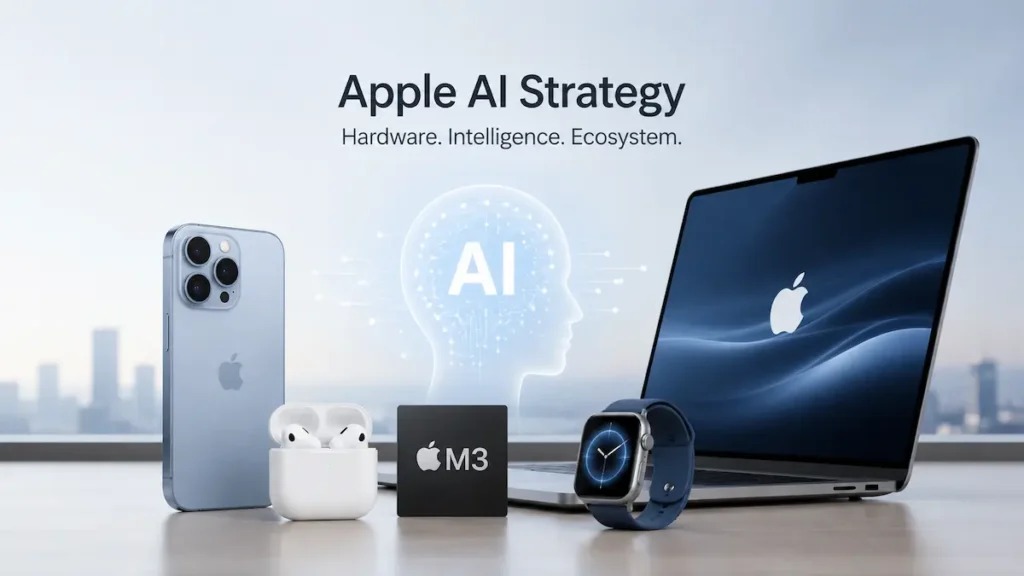
Rather than trying to win the AI model race, Apple is betting on something it already dominates—hardware, custom silicon, and a tightly integrated ecosystem.
Why Apple Chose a Different AI Strategy
Apple has never been a company that rushes to become the first.
Instead, it prefers becoming the company that delivers the best user experience.
While competitors compete for larger AI models and benchmark scores, Apple focuses on integrating AI into products millions of people already use every day.
Its ecosystem includes:
- iPhone
- Mac
- iPad
- Apple Watch
- AirPods
- Apple Silicon
- iOS
- macOS
- App Store
- iCloud
Rather than asking customers to adopt a completely new AI platform, Apple wants AI to become an invisible assistant built directly into every device.
This strategy places user experience above technical specifications.
The AI Race Is Becoming a Profitability Race
Over the past two years, technology companies have dramatically increased AI spending.
Billions of dollars have been invested in:
- AI data centers
- NVIDIA GPUs
- High-speed networking
- Energy infrastructure
- Cloud computing
- AI researchers
These investments are pushing innovation forward.
However, investors have started asking a different question:
Can these enormous investments generate sustainable profits?
Building advanced AI models is incredibly expensive.
Keeping them running is even more expensive.
Apple’s strategy addresses this concern by avoiding unnecessary infrastructure spending while still delivering AI-powered features through its existing ecosystem.
Apple’s Financial Advantage
One of Apple’s greatest strengths is financial discipline.
According to analyst estimates, Apple is expected to spend significantly less on AI-related capital expenditures than many of its competitors.
Instead of investing tens of billions of dollars into AI data centers every year, Apple leverages its existing hardware ecosystem and partners with external AI providers when appropriate.
This approach creates several advantages:
- Lower operating costs
- Strong free cash flow
- Higher profit margins
- More flexibility during economic uncertainty
- Continued investment in product innovation
For investors, profitability often matters more than headlines.
Hardware Is Becoming the Real AI Platform
One of the biggest misconceptions about artificial intelligence is that the best AI model automatically wins.
In reality, users interact with AI through devices.
Whether it’s asking an assistant to summarize emails, edit photos, schedule meetings, or translate conversations, the experience depends on the hardware as much as the AI model itself.
Apple controls nearly every part of that experience:
- Custom processors
- Operating systems
- Security architecture
- Device optimization
- Software integration
This vertical integration allows Apple to optimize AI features more efficiently than companies relying on third-party hardware.
The Rise of On-Device AI
Another major trend shaping the future is On-Device AI, also known as Edge AI.
Instead of sending every AI request to cloud servers, many tasks can now run directly on smartphones and personal computers.
Benefits include:
- Faster performance
- Better privacy
- Reduced cloud costs
- Offline functionality
- Improved battery efficiency
Apple has invested in custom chips for years through Apple Silicon and its Neural Engine.
As AI models become smaller and more efficient, on-device intelligence could become one of Apple’s biggest competitive advantages.
Apple’s Ecosystem Is Difficult to Copy
Technology companies can build AI models.
Building an ecosystem is much harder.
Today, Apple has more than 2.5 billion active devices worldwide.
That means new AI features can instantly reach billions of users without requiring them to change platforms or learn new software.
Imagine asking your AI assistant:
“Summarize today’s emails, add tomorrow’s appointments to my calendar, edit my vacation photos, and send the best ones to my family.”
When your smartphone, laptop, smartwatch, cloud storage, messaging apps, and payment services all work together, AI becomes far more useful.
This seamless integration is Apple’s greatest strength.
Apple Intelligence Could Change Everyday Computing
Apple’s vision is not necessarily to build the smartest chatbot.
Instead, it aims to make AI disappear into everyday life.
Rather than opening a separate AI application, users will simply interact naturally with their devices.
AI becomes part of:
- Writing emails
- Editing photos
- Organizing files
- Searching information
- Managing notifications
- Personal productivity
- Health tracking
- Smart home automation
For most consumers, this kind of invisible intelligence is likely to be more valuable than having access to the world’s largest AI model.
Challenges Apple Still Faces
Despite growing optimism, Apple is not without risks.
Several challenges remain:
- Competitors still lead in foundation AI models.
- AI innovation is moving extremely fast.
- Rising semiconductor costs may increase iPhone prices.
- Regulatory pressure on AI continues to grow.
- Consumer expectations for AI features are increasing every year.
To remain competitive, Apple must continue improving both its AI capabilities and hardware ecosystem.
Final Though
The AI industry is entering a new phase.
At first, success was measured by who built the biggest AI model.
Now, investors are asking a different question:
Who can build the most profitable AI business?
Apple’s answer is unique.
Instead of spending unlimited resources chasing larger AI models, the company is leveraging decades of expertise in hardware engineering, custom chips, software integration, and ecosystem design.
As artificial intelligence becomes a standard feature across smartphones, computers, and wearable devices, Apple’s strategy may prove that owning the platform is ultimately more valuable than owning the biggest AI model.
The future of AI may not belong solely to the companies building the smartest algorithms—it may belong to the companies that deliver the best user experience.
Frequently Asked Questions (FAQ)
Is Apple behind in AI?
Apple has taken a different approach by focusing on integrating AI into its hardware ecosystem rather than competing directly in large language model development.
What is Apple Intelligence?
Apple Intelligence is Apple’s AI platform designed to enhance productivity, communication, creativity, and everyday tasks across Apple devices while prioritizing user privacy.
Why is Apple’s hardware strategy important?
Apple controls both hardware and software, allowing it to optimize AI performance, security, battery life, and user experience more effectively than many competitors.
Will Apple’s AI strategy succeed?
While no outcome is guaranteed, Apple’s massive ecosystem, custom silicon, and strong financial position provide significant long-term advantages as AI becomes increasingly integrated into everyday devices.